

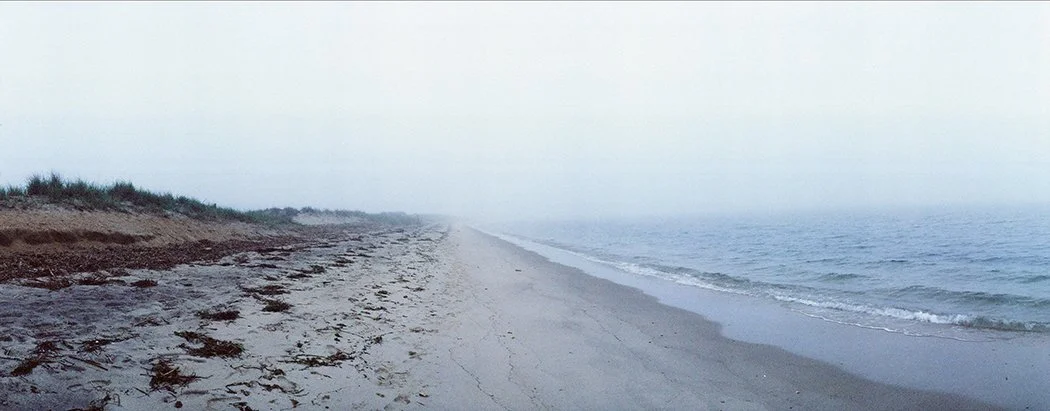
Section of beach along the Outer Cape in the fog. Captured using Kodak Ektar 100 on my Hasselblad 500C/M with a 50mm FLE lens.
5.30 am. My internal clock wakes me, and I scurry through a dark bedroom to shower and grab breakfast. Washed, fed and ready, I start the car and commute to work, spending twenty minutes travelling along a soulless, concrete highway. I arrive at work and spend most of my time in beige offices or meeting rooms, surrounded by others who share the same daily routine.
That was my life not so long ago: the hum and drum routine that one endures to support a life. But recently, a choice was made, and I found myself with an opportunity for change.
Change has always been a friend to me. I have never feared it or sought to run from it. It has been a faithful companion, one that reminds me from time to time that it is perhaps time to move on. Which is precisely what I did. I decided to start Cape Pines, a fine art photography business focused solely on the beauty and stillness of Cape Cod's natural landscapes and environment.
Many said this might be too narrow a focus, or that it was perhaps too specific. Others suggested it was risky, given the advent of AI and the ubiquity of smartphones. But I believe the risk of not doing it, the risk of not changing, is far greater and potentially far more dangerous.
So I dived in. Although I am still working through the many logistical challenges associated with starting a fine art photography business, I see no risk that cannot be deconstructed to its essence and tackled piece by piece.
A big part of change, and perhaps the force that prevents us from embracing it as a friend, is fear. During my MA in behavioural science, I became particularly interested in how fear, uncertainty and our perception of potential loss influence human decision-making, (Eidelman & Crandall, 2012). We are often more concerned about what we might lose than what we might gain. There is also a well-documented psychological tendency to favour the status quo, even when an alternative might offer something better. Researchers have described this as status quo bias, a preference reinforced by loss aversion, regret avoidance and familiarity.
Perhaps this helps explain why we sometimes remain on a path that no longer makes us happy or fulfils us. Our fear of the unknown can be powerful, while the familiar, even when unsatisfying, offers a certain comfort. We continue along the same path, often without questioning it, until something stops us or nudges us in a different direction. If we are lucky, of course, we recognise change is our friend, and follow it’s advice.
I think, somewhere deep in my unconscious, it is change that attracts me to the Cape. The Cape is constantly changing, and no two visits to the same place ever feel quite the same. For me, there is a comfort in that, a sort of familiarity that I feel at home with. Knowing that things will not always be there reminds me that we must enjoy and savour them while we can. It is a sort of memento mori, if you will: a reminder of our mortality and the brief nature of our time here.
The early settlers of New England understood this sentiment, too. Their gravestones often carried images of winged skulls, known as death's heads, a stark reminder of mortality and the transience of life, (Wilson Green, 2021). These were not simply decorative motifs; they reflected a culture in which death and the afterlife were very much part of everyday contemplation.
I recently came across an archaeological account of an eighteenth-century plate bearing an inscription that I found particularly moving. The plate, a piece of Dutch earthenware dating from 1661, was excavated from a London sewer. Its inscription reads, (London Museum, n.d.):
“You and I are Earth.”
A simple but rather profound reminder that we are all made of the same material to which, one day, we will return. Whilst we are here, perhaps we should embrace change and live our lives as we intend and choose, rather than simply following the default choices of others.
So, for me, change is something to embrace. In fact, it is something I actively seek, not only in capturing it through my photography, but also in embracing it as a way of living. I know that at times it can be difficult, and sometimes it might even feel impossible, but I am increasingly convinced that unquestioningly subscribing to the status quo can be far more dangerous.
A little about my last project for the year.
I have been reading a lot of Henry David Thoreau recently. Over the past two weeks, I have immersed myself in a biography of Thoreau and have just started reading Walden. His love of nature and his connection to it are things I share, and perhaps another reason why I feel so drawn to the Cape.
So I decided to attempt to retrace some of his footsteps through photography, turning them into a small end-of-year project inspired by Thoreau's journeys across Cape Cod.
I revisited and photographed some of the places he wrote about, using both my Hasselblad 907X 100C and, in keeping with my newfound enthusiasm for change, something a little different. I experimented with a new film, Mercury Works Cine 250 Daylight, which I had to bulk-load into a Hasselblad A70 film back. This involved learning a whole new way of loading film and adapting the way I use my Hasselblad 500C/M.
I am still waiting to receive my film back from the processing lab at Mercury Works. There is always the possibility that I made a mistake and have nothing to show for it, but again, I think that is a risk worth taking.
I also shot eight rolls of Kodak Ektar 100, one of my favourite films to use. I should have those back on Friday, by which time I will also have processed and sorted through the digital photographs I took.
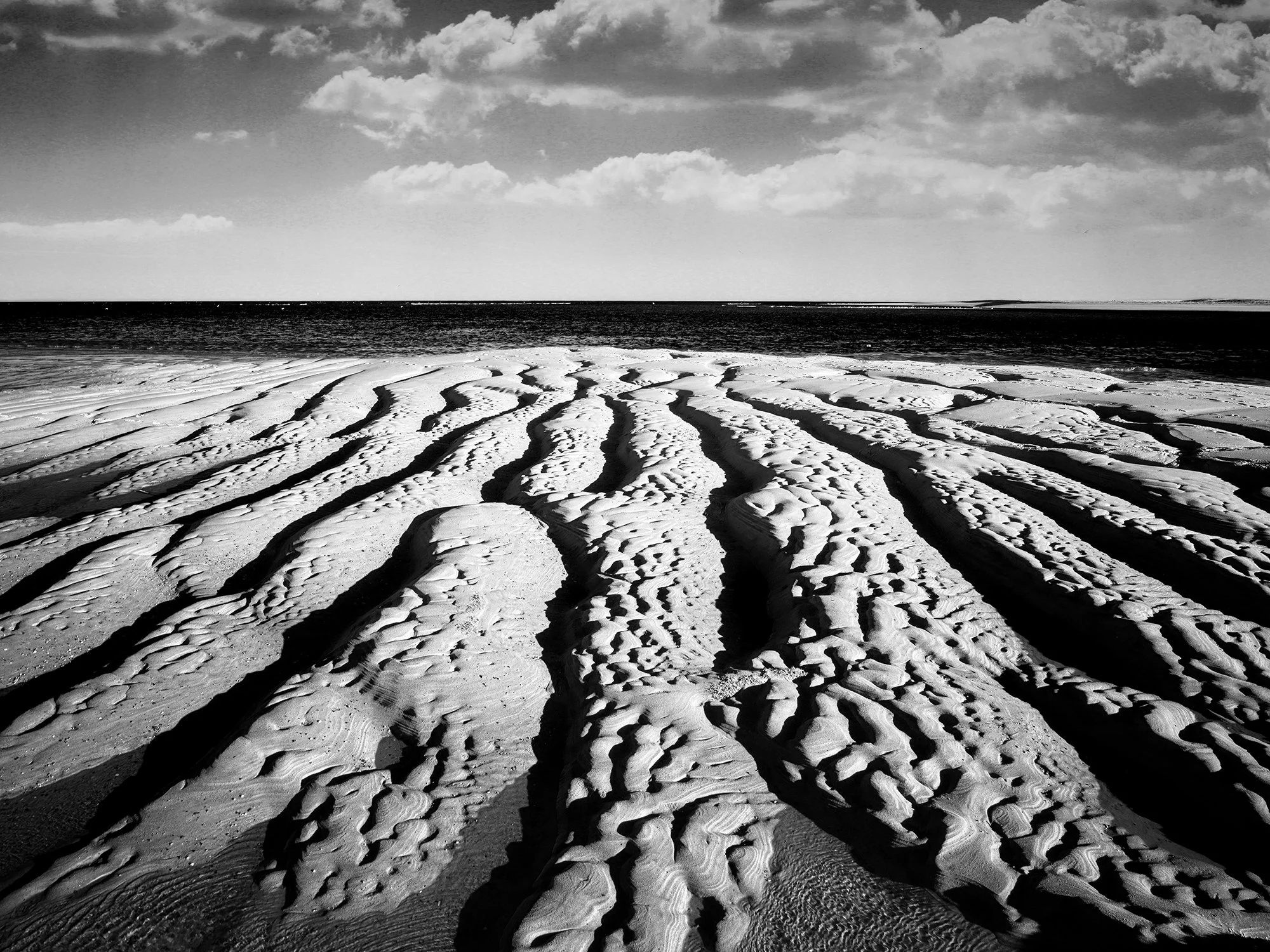
The changing sandbars out on Nauset Beach, along the Outer Cape. Captured using my Hasselblad 907× 100c.
My hope is that I can bring everything together to form a new collection based on Thoreau's travels across the Cape and publish it on www.capepines.com.
I will make some of the photographs available for sale, but I intend to share the entire collection on my portfolio page for everyone to enjoy.
For now, though, I want to do as promised and offer one photograph here in this post, free of charge. It is my way of saying thank you to those who follow along, and perhaps a small reminder to all of us to seek out change and embrace it.
Make friends with change. Treat it like an old friend who reminds you from time to time to keep moving, to question the familiar and, above all, to remember that life is short. Live the life you want, rather than the life others might expect of you.
Many thanks for following Cape Pines and if you find value or enjoyment in these posts, please share them with others whom you think might feel the same.
Sincerely,
G.
References
1. Behavioural science – Status quo bias: Eidelman, S., & Crandall, C. S. (2012). Bias in favor of the status quo. Social and Personality Psychology Compass, 6(3), 270–281. https://doi.org/10.1111/j.1751-9004.2012.00427.x
2. Memento mori – Historical gravestone symbolism: Wilson Green, J. (2021, July 15). Remembering what we'd rather forget—Memento mori. Virginia Department of Historic Resources. https://www.dhr.virginia.gov/blog-posts/remembering-what-wed-rather-forget-memento-mori/
3. The 1661 earthenware plate – You and I are Earth: London Museum. (n.d.). Inscribed dish. https://www.londonmuseum.org.uk/collections/v/object-113833/inscribed-dish/